
This guide explains essential marketing tools examples across analytics, SEO, content creation, social media, email, and CRM systems, showing how these platforms improve efficiency, automation, scalability, and data-driven decision-making for modern digital marketing success.
The digital marketing landscape shifts constantly. Algorithms change, new platforms emerge, and consumer behaviors evolve rapidly. Navigating this environment without the right technology is like trying to build a house without a hammer. You might eventually get something standing, but it will take much longer and look far less professional.
Finding the right marketing tools examples for your business can feel overwhelming. Software categories overlap, and every vendor claims their product is the missing key to your success. Cutting through the noise requires a clear understanding of what these tools actually do and how they fit into your broader strategy.
This comprehensive guide breaks down the essential software for businesses of all sizes. You will learn about different software categories, explore real-world marketing tools examples, and discover how implementing the right tech stack can drive growth, efficiency, and revenue.
Understanding the Marketing Tools Ecosystem
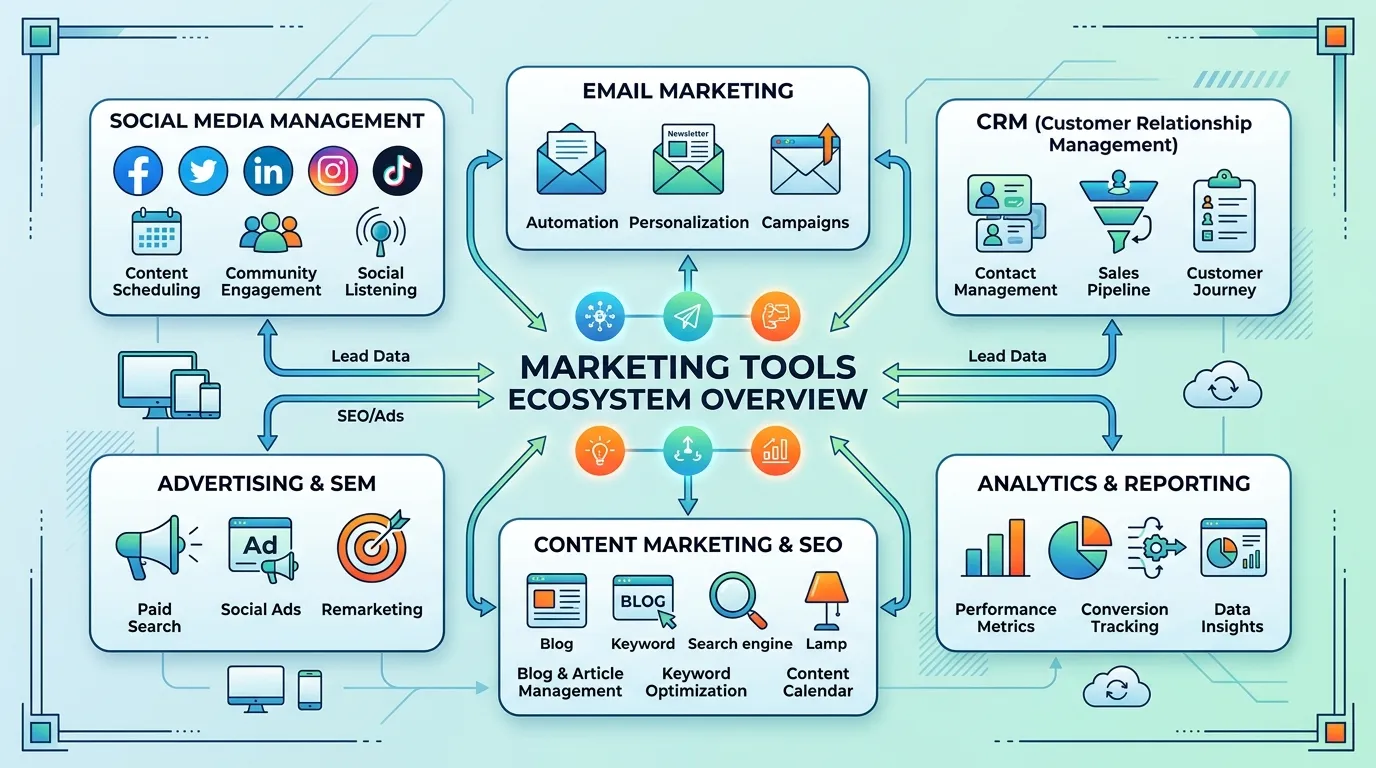
Marketing software has become non-negotiable for business growth in today’s digitally-driven world. The speed and complexity of modern marketing campaigns require the kind of scale, automation, and insight that only the best marketing tools can offer.
Why Invest in Marketing Tools?
- Drastic Efficiency Improvements: Automate repetitive tasks like posting on social media or sending welcome emails.
- Data-Driven Decisions: Stop guessing what your audience wants and start looking at the actual numbers.
- Massive Scalability: As your business grows, your software easily handles the increased workload without requiring proportional increases in headcount.
- Competitive Advantage: A strong tech stack allows you to move faster and target smarter than competitors who still rely on manual spreadsheets or outdated systems.
- Centralized Operations: Many of today’s tools integrate seamlessly, allowing you to consolidate data, boost cross-team collaboration, and eliminate information silos.
Categories of Marketing Tools
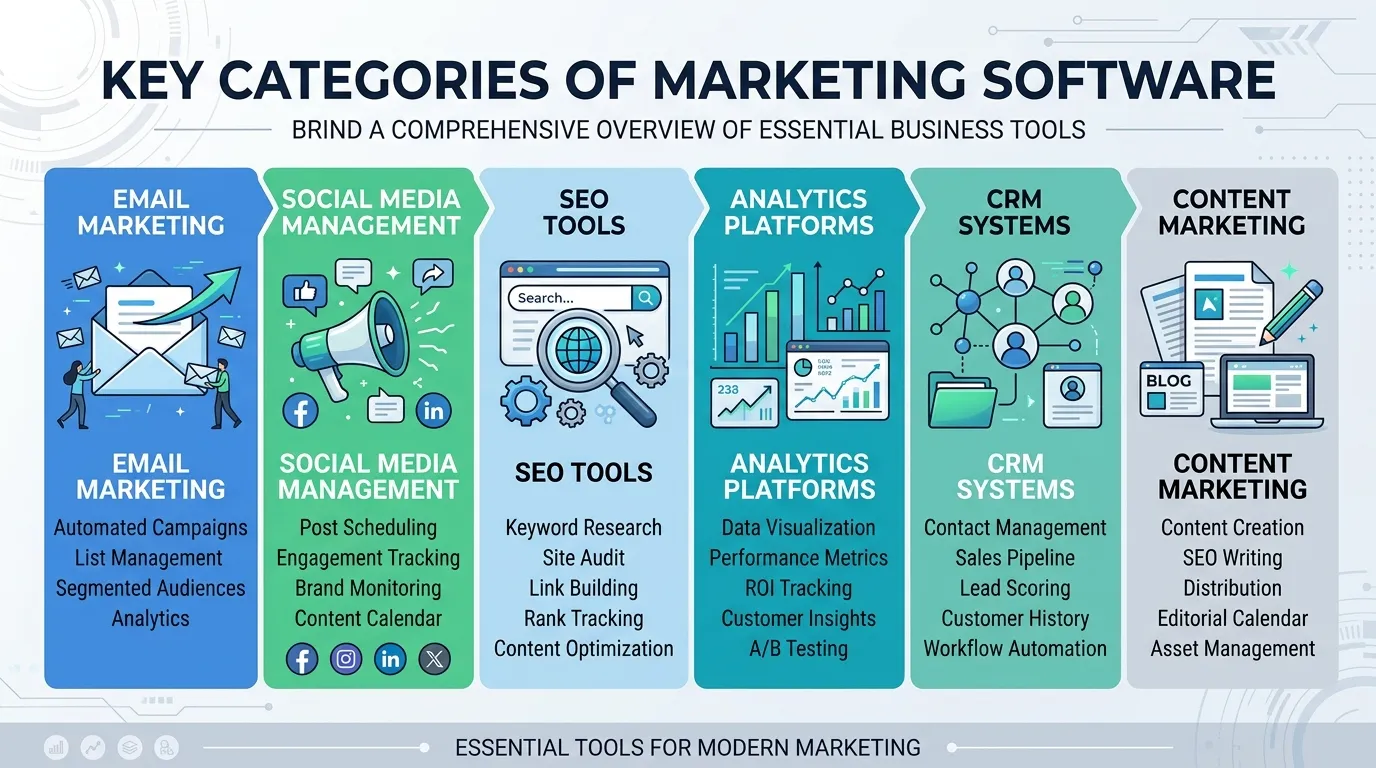
The marketing ecosystem generally breaks down into a few core categories. These include:
- Analytics tools: Provide actionable insights on traffic, behavior, and campaign performance.
- SEO tools: Maximize search rankings by optimizing site content, structure, and authority.
- Content creation platforms: Empower you to create high-quality, engaging media.
- Social media tools: Schedule posts, monitor engagement, and analyze social campaigns.
- Email marketing tools: Automate list management, send campaigns, and improve open rates.
- Customer relationship management (CRM): Manage leads, pipeline, and ongoing relationships.
Let’s dive deeper into each to see what sets the best marketing tools examples apart in practice.
Website Analytics Tools
Understanding how people find and interact with your website is the absolute foundation of digital marketing. Analytics tools provide the deep visibility you need to optimize your online presence and ensure your campaigns actually generate a positive return on investment.
Google Analytics
Google Analytics remains the industry standard for tracking website traffic, user behavior, and conversions. It provides real-time data on exactly who is visiting your site and how they got there.
Key Features:
- In-depth audience insights
- Detailed traffic sources and path analysis
- Conversion tracking and sales funnel visualization
- Custom goal and event setting
- Integration with ad platforms, search console, and more
By analyzing this data, marketers can heavily optimize the user experience. You can identify your most popular content and find bottlenecks where users drop off, ultimately improving your overall conversion rates.
Expanding Your Analytics Stack
While Google dominates the space, you might need different features based on your platform. Discover the best web analytics tools to track your metrics.
Other analytics solutions offer heatmaps (such as Hotjar or Crazy Egg), session recordings, and advanced attribution modeling. Leveraging more than one platform means you’ll get a more complete picture of your actual customer journeys.
Considerations When Choosing Analytics Software:
- Ease of integration
- Depth and versatility of reporting
- Data visualization options
- Cost, scalability, and support
SEO Tools
Getting found on search engines requires precision. SEO tools help you understand search intent, audit your technical performance, and monitor your rankings against fierce competitors. These marketing tools examples are mandatory for any inbound strategy.
Google Search Console
While standard analytics track what users do on your site, Google Search Console helps you understand how search engines view your site. This tool monitors search performance and identifies critical indexing issues that could prevent you from ranking.
Key Features:
- Search performance and keyword data
- Indexing status and coverage reports
- Sitemap submission and error monitoring
- Page experience and Core Web Vitals insights
Using this tool is essential for improving your technical SEO and troubleshooting website errors quickly.
SEMrush and Ahrefs
Comprehensive platforms like SEMrush and Ahrefs take your search strategy to an entirely different level. These platforms are designed for deep keyword research, competitor analysis, backlink monitoring, and extensive technical site audits.
On-Page Optimization Features
They feature powerful keyword magic tools, position tracking, and content gap analysis. Leveraging these specific marketing tools examples allows you to develop highly effective search strategies. You can find lucrative keywords your competitors are missing and actively outrank them in the search engine results pages.
Other Powerful SEO Tools:
- Moz Pro (for link metrics and keyword analysis)
- Screaming Frog (for technical site crawls)
- Yoast SEO (WordPress optimization)
- SurferSEO (for content scoring and optimization)
- Ubersuggest (for competitive keyword ideas)
Content Marketing and Creation Tools
Content is the fuel for your marketing engine. High-value content attracts, informs, and converts prospective customers. You need robust systems to build, design, and refine that content before publishing it to the world.
Content Management Systems: WordPress
A Content Management System (CMS) like WordPress is essential for creating, managing, and publishing website content. It acts as the central backbone of your digital presence.
Benefits:
- User-friendly interface with WYSIWYG editor
- Thousands of free and paid themes/plugins
- Flexible enough for blogs, commerce, or portfolios
- Easy to optimize for SEO and integrate analytics
WordPress powers over 40% of the web and provides a scalable platform that works for small blogs and large enterprise sites alike.
Graphic Design Tools: Canva and Adobe Spark
Visual communication is mandatory for capturing attention. Graphic design tools like Canva and Adobe Spark allow marketers to create stunning visuals for blogs, landing pages, advertisements, and social feeds.
Why Visual Content Matters:
- 90% of information transmitted to the brain is visual
- Posts with images receive up to 2.3x more engagement on social media
Both Canva and Adobe Spark provide drag-and-drop interfaces, masses of templates, integrated stock imagery, and flexible export options. They empower non-designers to build professional quality graphics quickly and affordably.
Writing and Editing Tools: Grammarly and Hemingway Editor
Good writing builds instant trust with your audience. Tools like Grammarly and the Hemingway Editor exist to improve your writing quality, fix grammar mistakes, and heavily enhance readability.
- Grammarly checks for grammar, spelling, clarity, and even tone.
- Hemingway Editor focuses on simplifying prose, removing passive voice, and tightening sentence structure.
Other Useful Content Tools:
- Jasper (AI copywriting)
- Quillbot (paraphrasing and summarizing)
- Google Docs (real-time team editing)
Using these marketing tools examples guarantees completely error-free content. Clear, concise writing enhances reader engagement and maintains a professional tone that reflects well on your brand’s reputation.
Social Media Tools
Managing multiple social profiles natively is a massive drain on your resources. Centralized software streamlines your marketing and amplifies your reach.
Social Media Management: Hootsuite and Buffer
Platforms like Hootsuite and Buffer allow you to seamlessly schedule posts, monitor engagement, and analyze performance across various networks from a unified dashboard.
Key Benefits:
- Unified inbox for managing audience conversations
- Content calendar for planning campaigns in advance
- Detailed analytics and reporting dashboards
- Team collaboration and approval workflows
Blocking out time to schedule a week (or month) of content in one sitting keeps your feed consistent, freeing up your time for engagement and ideation.
Social Listening Tools: Mention and Brandwatch
Social media is a conversation, not just a broadcast. Social listening tools like Mention and Brandwatch scan social platforms, blogs, forums, and news sites for brand mentions, trends, and competitor activity.
Features to Look For:
- Real-time alerts for specific keywords or hashtags
- Advanced sentiment analysis (positive, negative, neutral)
- Trend identification and influencer tracking
- Customizable dashboards for performance tracking
Effective listening lets you respond faster, spot emerging opportunities, and stay ahead of any PR issues.
Email Marketing Tools
Email remains one of the highest-converting marketing channels available to modern businesses. Proper email marketing tools are required to manage large subscriber lists and execute campaigns effectively.
Mailchimp and Constant Contact
Mailchimp and Constant Contact serve as prime marketing tools examples for building massive email lists, sending broadcast campaigns, and deeply analyzing subscriber engagement.
Key Email Features:
- Drag-and-drop builders for beautiful email templates
- Smart segmentation for targeted campaigns
- Automated workflows for onboarding, retention, and follow-up
- A/B testing for subject line and content optimization
- Analytics on open rates, click-throughs, and conversions
Automation Workflows
Automating emails—like welcome series, cart abandonment reminders, and triggered post-purchase follow-ups—builds relationships and recaptures otherwise lost sales.
Advanced Email Tools:
- ConvertKit (for creators and bloggers)
- ActiveCampaign (advanced automation and CRM features)
- Drip (eCommerce-focused automations)
CRM and Sales Enablement Tools
Marketing generates the interest; sales closes the deal. The vital bridge between these two critical functions is the Customer Relationship Management (CRM) system.
HubSpot CRM and Salesforce
Platforms like HubSpot CRM and Salesforce are custom-built for managing customer relationships, tracking interactions, and aligning your sales and marketing teams perfectly.
Why CRM Matters:
- Every lead and customer interaction is tracked
- Automatic logging of calls, emails, meetings, and notes
- Full-funnel reporting shows which campaigns generate revenue
- Artificial intelligence offers lead scoring and next-step recommendations
The best CRMs also integrate directly with marketing, support, and accounting platforms, ensuring no customer falls through the cracks.
Sales Enablement Software
Beyond CRM, today’s tools support every sales touchpoint—from proposal generation (e.g., PandaDoc) to e-signatures (e.g., DocuSign) and pipeline forecasting (e.g., Pipedrive).
Sales Enablement Benefits:
- Automated follow-up reminders and task management
- Integrated document sharing and storage
- Analytics on sales rep activity and deal pipeline health
Comparison of Essential Marketing Software
To help you visualize your options, here is a quick breakdown of the most common marketing tools examples by category.
|
Tool Category |
Top Example 1 |
Top Example 2 |
Primary Business Benefit |
|---|---|---|---|
|
Analytics Tools |
Google Analytics |
Hotjar |
Tracks user behavior and conversion bottlenecks. |
|
SEO Tools |
SEMrush |
Ahrefs |
Uncovers competitor keywords and backlink data. |
|
Social Media Tools |
Buffer |
Hootsuite |
Automates posting schedules across all platforms. |
|
Email Marketing |
Mailchimp |
Constant Contact |
Nurtures leads through automated drip campaigns. |
|
CRM Systems |
HubSpot |
Salesforce |
Aligns marketing data directly with sales pipelines. |
Integrating Your Marketing Tools for Maximum ROI
Having powerful standalone software is beneficial, but integrating your tech stack yields even greater results. When marketing tools easily exchange data (via APIs or native integrations), you create a seamless flow of information between analytics, CRM, content platforms, and more.
Examples of Smart Integrations:
- Pushing form leads from your site directly into your CRM
- Triggering automated email sequences based on website behavior (e.g., Mailchimp + WordPress)
- Syncing performance reports from analytics tools directly into your dashboard for an all-in-one view
Many top tools offer “marketplaces” of pre-built integrations. Check documentation or support to discover which connections come easily and where you might need middleware like Zapier.
Trends Influencing the Future of Marketing Tools
The world of marketing software doesn’t stand still. As you evaluate platforms, keep an eye on these fast-moving trends:
- AI and Machine Learning: Many tools now offer AI-powered copywriting, predictive analytics, and automated campaign optimization.
- Cross-Channel Campaigns: The best marketing tools examples let you manage content, ads, emails, and social posts from the same dashboard.
- Privacy Compliance: Built-in support for regulations like GDPR and enhanced consent management are becoming must-haves.
- Data Visualization: Clear dashboards and custom reporting are quickly replacing clunky spreadsheets.
- No-Code Platforms: Marketers with little-to-no developer experience can now build sophisticated, automated workflows with drag-and-drop logic.
Tips for Getting the Most from Your Marketing Tools
- Start with your bottlenecks: Don’t try to implement everything at once. Solve for the biggest pain point first—be it manual reporting, inconsistent social presence, or poor lead tracking.
- Prioritize platforms with learning resources: The best software is only useful if you know how to use it. Choose vendors with robust training materials and active communities.
- Leverage free trials: Most platforms offer risk-free trial periods. Use these to test integration, usability, and actual ROI before fully committing.
- Document your processes: Create a handbook for your team on how to use each tool and standardize best practices. This improves training and continuity as teams grow.
Ready to Build Your Tech Stack?

Selecting the right marketing software fundamentally changes how your business operates daily. It shifts your team from reactive, manual tasks to highly proactive strategy planning.
By exploring these various marketing tools examples, you can easily identify the operational gaps in your current workflow and choose the specific platforms that will drive your business forward. Start small. Pick one single category where you struggle the most—perhaps social media scheduling or SEO research—and implement a dedicated tool today to see immediate operational improvements.
Frequently Asked Questions
What are the best marketing tools examples for beginners?
For beginners, Google Analytics, Mailchimp, and Canva serve as perfect starting points. They offer free tiers, feature incredibly user-friendly interfaces, and cover the essential bases of traffic tracking, email outreach, and graphic design without overwhelming new users.
How do SEO tools actually help my website rank higher?
SEO tools analyze your site’s technical health, track your specific keyword positions, and spy on competitor backlinks. They provide actionable data so you can optimize your pages, fix broken links, and write content that perfectly matches what search engines want to see.
Are email marketing tools still relevant today?
Yes, email marketing tools generate some of the highest returns on investment in the digital space. They allow you to own your audience directly, bypass unpredictable social media algorithms, and send highly personalized promotions straight to interested buyers.
What is the primary difference between social media tools and social listening tools?
Social media management tools focus primarily on scheduling content and tracking direct engagement on your posts. Social listening tools scan the entire internet to find unlinked mentions of your brand, monitor general industry sentiment, and track competitor conversations.
How much should a small business spend on marketing tools?
A small business can build a highly functional stack for under $100 a month by utilizing free versions of robust tools like HubSpot CRM, Mailchimp, and Canva. As revenue grows, you can gradually upgrade to paid tiers to unlock advanced automation features.
Why do I need a CRM if I already use email marketing tools?
While email tools send blasts, a CRM tracks the entire lifecycle of an individual customer across multiple touchpoints. It records phone calls, meeting notes, and website visits, giving your sales team the complete context they need to close a specific deal.
How do I choose between different marketing tools examples?
Start by clearly identifying your biggest operational bottleneck, then utilize free trials to test software usability. Ensure the tool integrates seamlessly with your existing platforms, fits your monthly budget, and offers reliable customer support for your team.
What strategies work best once I set up my tools?
Having the right tools is only the first step; you need a solid strategy to execute. Review the top website marketing strategies for growth to maximize your setup. Combine high-quality content creation with automated lead nurturing for the best results.
Can analytics tools track individual user behavior?
Yes, advanced analytics tools and heat mapping software can track individual user journeys across your site. They record where users click, how far they scroll down a page, and exactly where they abandon their shopping carts, providing deep usability insights.
Is it better to use an all-in-one platform or specialized tools?
All-in-one platforms offer incredible convenience and seamless data integration across departments. However, specialized tools generally offer deeper, more advanced features for specific tasks. Choose based on your team’s technical expertise and specific campaign requirements.