
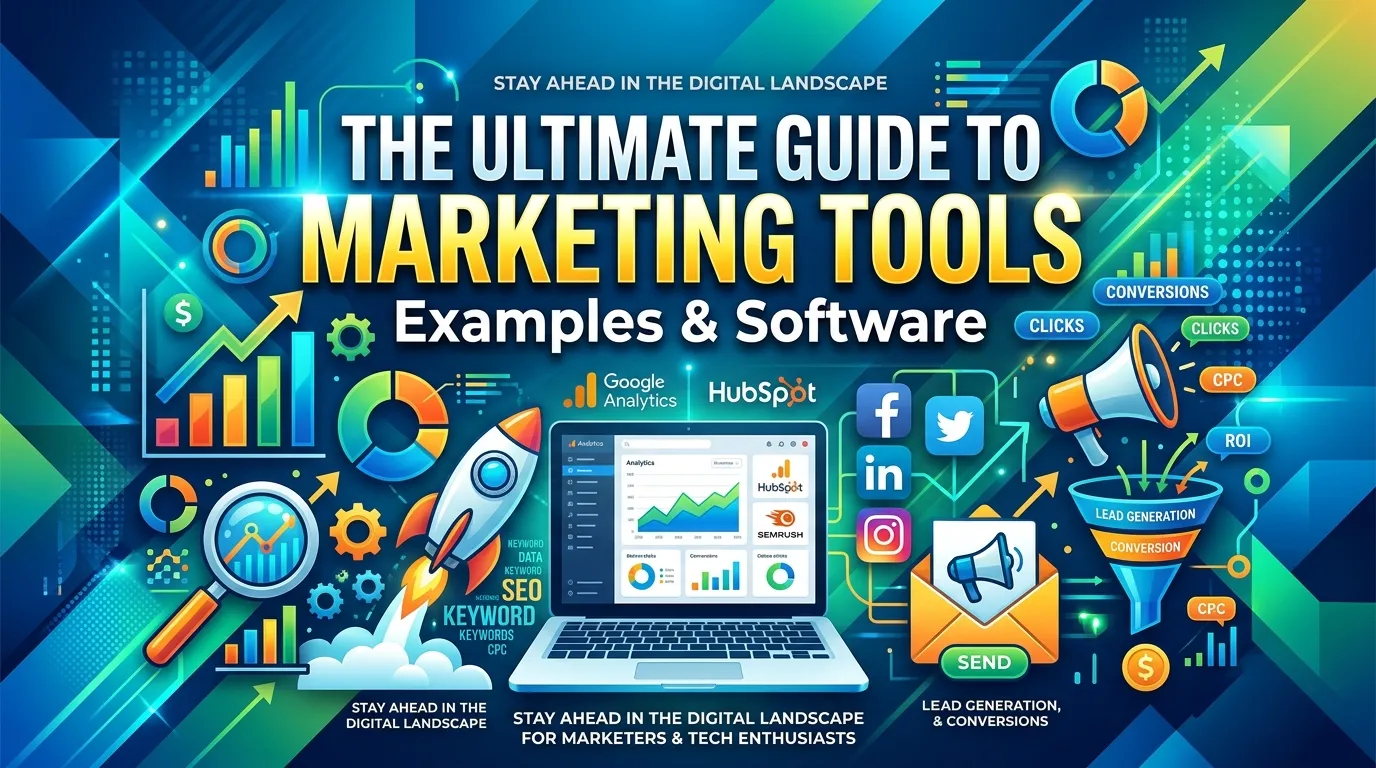
Marketing tools help businesses automate campaigns, improve targeting, analyze customer behavior, and boost ROI. From SEO and email marketing to CRM and analytics, the right digital tools streamline workflows, improve efficiency, and support scalable business growth.
Marketing a business effectively requires a lot more than just a good product and a catchy slogan. Modern marketing teams juggle dozens of campaigns, channels, and data streams simultaneously. Keeping track of all these moving parts without dropping the ball is nearly impossible if you rely on spreadsheets and manual tracking. That is exactly where marketing tools come into play.
Digital platforms designed to help businesses promote their products automate repetitive tasks, gather crucial customer data, and provide actionable insights. From tracking search engine rankings to automating email sequences, these applications form the backbone of any successful growth strategy.
By leveraging the right software, teams can streamline workflows, reach highly targeted audiences, and measure the exact return on investment for every dollar spent. This guide explores the most essential categories of marketing software, providing top marketing tools examples to help you build a highly effective technology stack.
The Evolution of Digital Marketing Tools
The evolution of marketing software over the past decade has been remarkable. We moved from simple email blast software to sophisticated platforms that predict customer behavior using artificial intelligence. This shift democratized high-level marketing, allowing small businesses to compete with global enterprises.
These advancements mean any company—regardless of size—can launch targeted marketing campaigns, test ideas rapidly, and pivot to what works without wasting valuable resources. The democratization of tools previously only available to major corporations has created new opportunities for nimble startups and budget-conscious entrepreneurs.
Using modern digital marketing tools, you can easily segment your audience, track user journeys, and adjust your messaging in real time. Instead of guessing what your audience wants, you rely on hard data. Exploring different marketing tools examples allows you to see exactly how these platforms solve complex business problems.
Leveraging artificial intelligence, machine learning, and automation has also made campaign management more efficient. Marketers can use predictive analytics to forecast results, automate repetitive reporting, and trigger personalized outreach with minimal manual oversight. This not only saves time but also enables innovation, allowing marketers to focus on creative strategy and relationship-building.
Core Benefits of Building a Tech Stack

When you implement the right marketing tools examples, you experience several immediate benefits:
- Time Savings: Automation handles repetitive tasks like sending welcome emails or scheduling social posts, freeing your team to focus on strategic growth.
- Data Accuracy: Software eliminates human error in tracking and reporting, making higher-level analysis and forecasting more reliable.
- Better Targeting: Advanced algorithms help you find exactly who wants to buy your product, so you stop wasting resources on the wrong audiences.
- Higher ROI: You can see exactly which campaigns generate revenue and which waste money, so you can quickly refine your strategy for optimal returns.
- Scalability: As your business grows, a well-chosen tech stack grows with you. Modern marketing tools examples are built to handle increasing workloads, contacts, and campaign complexity without sacrificing performance.
- Cross-Channel Consistency: Integration capabilities allow you to carry a unified message across platforms—whether through email, social, paid ads, or your website—helping you present a cohesive brand story.
Essential Categories and Marketing Tools Examples
Understanding the software landscape becomes much easier when you break it down into core functions. Most digital marketing tools fall into one of several distinct categories, each serving a specific purpose in the customer journey.
To ensure you build a balanced ecosystem, let’s go deeper into each category and see how different tools can dramatically improve your campaign results.
SEO Marketing Software
Search Engine Optimization (SEO) tools ensure your target audience can actually find your website on Google and other search engines. They help you understand what your potential customers search for and how you can optimize your site to meet those needs. Good SEO marketing software acts as a roadmap for your content strategy.
SEO platforms also provide valuable competitor insights, showing you where you stand versus others in your industry. Features like keyword tracking, backlink monitoring, and site audits help you refine both your technical and content strategies.
Top SEO Marketing Software Options
- SEMrush is a comprehensive platform that handles everything from keyword research to competitive analysis. It allows marketers to see exactly which keywords their competitors rank for, revealing opportunities to capture lost traffic. This makes it one of the most powerful marketing tools examples available today.
- Ahrefs is another industry giant, particularly renowned for its backlink analysis capabilities. It helps teams understand the link profile of their own website and discover new link-building opportunities.
- Moz offers a highly user-friendly interface, providing excellent site audit features that crawl your web pages to identify technical issues hurting your rankings.
- Ubersuggest is another newcomer gaining popularity for its easy-to-use keyword suggestion and site audit tools.
- Screaming Frog specializes in site crawling, helping pinpoint technical SEO issues that may hurt your rankings.
By combining several SEO marketing tools, companies can track both on-page and off-page factors, ensuring nothing falls through the cracks.
Social Media Marketing Tools
Maintaining an active presence across multiple social networks requires serious organization. Social media marketing tools centralize this process, allowing you to control all your brand’s accounts from a single dashboard.
In addition to post scheduling and analytics, newer social media platforms offer advanced audience targeting, social listening, content curation, and A/B testing for headlines and visuals. This allows marketers to refine their message through real-time feedback and trend analysis.
Platforms like Hootsuite and Buffer excel at content scheduling. Instead of logging into five different apps every morning, you can write a week’s worth of posts and schedule them to publish at optimal times automatically. Sprout Social takes this a step further by offering deep analytics and engagement features. It provides unified inboxes so community managers can respond to comments across all networks in one place.
If you want to master this specific channel, read more about social media marketing strategies.
Other emerging marketing tools examples in the social space include:
- Later: Focused on visual channels like Instagram with handy post preview tools.
- SocialBee: Offers powerful automation for posting, recycling evergreen content, and managing multiple brands.
- Agorapulse: Provides deep competitor benchmarking and advanced reporting.
Each platform addresses different pain points, so businesses should choose the one that fits their social footprint and goals.
Email Marketing Platforms

Email remains one of the most reliable channels for driving conversions and nurturing leads. Modern email marketing platforms do much more than just send messages; they deliver highly personalized experiences at scale.
Automation features make it possible to trigger complex workflows based on user behavior—welcoming new subscribers, reminding users about abandoned carts, or nurturing leads over time. Data segmentation, A/B testing, and advanced reporting features are essential in optimizing these campaigns.
Mailchimp is often the go-to choice for growing businesses due to its intuitive drag-and-drop builder and accessible pricing. For teams needing more advanced automation, ActiveCampaign or Constant Contact offer robust segmenting features. You can trigger specific emails based on user behavior, like sending a discount code when a user abandons their shopping cart. HubSpot incorporates email marketing directly into its broader ecosystem, offering seamless campaign tracking.
Additional popular email marketing tools examples include:
- ConvertKit: Ideal for content creators and bloggers, it simplifies audience tagging and autoresponders.
- GetResponse: Offers webinar integrations and e-commerce tailored automation.
- Drip: Highly focused on e-commerce stores with deep Shopify integrations and complex workflow capabilities.
The best email marketing platforms support scalability, compliance (GDPR, CASL, CAN-SPAM), and advanced analytics for true performance insight.
Customer Relationship Management (CRM) Systems
Customer Relationship Management systems function as the central nervous system for your sales and marketing efforts. They store every interaction a prospect or customer has with your brand, ensuring your messaging remains relevant and timely.
CRM tools foster better collaboration between marketing and sales teams. Advanced CRMs offer AI-powered lead scoring, pipeline visualization, and workflow automation, keeping your sales funnel healthy and maximizing conversion potential.
Salesforce is the undisputed heavyweight in this category, offering infinite customization for enterprise-level lead management and sales pipelines. For small to mid-sized businesses, Zoho CRM provides an affordable yet powerful alternative for tracking customer interactions. HubSpot CRM is uniquely beneficial because it is entirely free to start and integrates flawlessly with HubSpot’s marketing hubs.
Other noteworthy CRM marketing tools examples include:
- Pipedrive: Visualizes entire sales pipelines with easy-to-use drag-and-drop stages.
- Nimble: Focuses on social CRM, aggregating contacts and conversations from across your platforms.
- Freshsales: Combines CRM with email, phone, and chat for all-in-one sales enablement.
Efficient CRMs offer integrations with other marketing tools, so your emails, ads, and content marketing efforts are all informed by up-to-date customer records.
Content Marketing Platforms
Creating content that resonates with your audience and ranks well requires strategy and data. Content marketing platforms help teams generate ideas, optimize written material, and distribute it effectively. Looking at these marketing tools examples shows how technology improves creative processes.
The right content tools facilitate editorial planning, keyword placement, and SEO guidance, ensuring every piece published supports your goals.
Clearscope uses natural language processing to grade your content against top-ranking search results, ensuring your articles cover all the necessary subtopics to satisfy search intent. BuzzSumo is an incredible tool for content ideation. It allows you to search for a topic and immediately see the most shared and linked-to articles across the web.
Additional platforms for content strategy include:
- Trello/Asana: Useful for managing editorial calendars within a collaborative team structure.
- SurferSEO: Helps you optimize for search intent and structure using real-time SERP analysis.
- Grammarly: Improves clarity and grammar across all written communications.
Combining these content marketing tools examples ensures your content stands out, ranks highly, and meets your overall business objectives.
Analytics and Reporting Tools
If you cannot measure your efforts, you cannot improve them. Analytics tools process raw data and turn it into visual, easy-to-understand reports.
Besides traditional analytics, newer platforms dive into customer attribution, revenue tracking, cohort analysis, and predictive analytics—helping you attribute success (or failure) to specific campaigns across digital marketing tools.
Google Analytics is the foundational tool for measuring website performance. It tracks traffic sources, user behavior, and conversion rates, providing the data necessary to evaluate campaign success. Tableau and Looker take data visualization to the next level. They can pull data from dozens of different sources—including your CRM, email marketing platforms, and website—and compile it into interactive dashboards.
Other advanced analytics marketing tools examples include:
- Mixpanel: Focuses on product analytics and user retention funnels.
- Kissmetrics: Excellent for e-commerce behavior tracking and conversion analysis.
- Crazy Egg/Hotjar: Visualize heatmaps, scroll maps, and user recordings, revealing exactly how visitors interact with your site.
PPC and Advertising Tools
Pay-Per-Click advertising requires careful budget management and constant optimization. Advertising tools help marketers create, bid on, and refine campaigns to ensure the lowest possible cost per acquisition.
Newer PPC platforms incorporate AI-driven optimization, smart bidding, and dynamic ad creation to streamline campaigns. This allows marketers to quickly iterate on messaging and creative without deep technical knowledge.
Google Ads is the primary platform for capturing high-intent search traffic. It provides detailed controls for keyword bidding, ad scheduling, and audience targeting. Meta Ads Manager dominates the social advertising space. Its granular targeting capabilities allow marketers to show ads to users based on incredibly specific demographics, interests, and behaviors.
Additional key platforms include:
- AdEspresso: Simplifies Facebook and Instagram ad creation with real-time feedback.
- SpyFu: Uncovers competitor PPC keywords and ad copy for better strategic planning.
- WordStream: Aggregates ad management across Google, Bing, and Facebook in a single dashboard.
Comparing Top Marketing Tools Examples
To help you visualize how these platforms stack up, here is a quick comparison table of popular digital marketing tools.
|
Tool Name |
Primary Category |
Best Feature |
Ideal Business Size |
|---|---|---|---|
|
SEMrush |
SEO marketing software |
Competitor keyword analysis |
Mid to Enterprise |
|
Buffer |
Social media marketing |
Simple scheduling queues |
Small to Mid |
|
Mailchimp |
Email marketing platforms |
Drag-and-drop campaign builder |
Small to Mid |
|
HubSpot |
CRM & Inbound Marketing |
Unified customer data platform |
All Sizes |
|
Clearscope |
Content Optimization |
NLP-driven content grading |
Mid to Enterprise |
|
AdEspresso |
PPC/Advertising |
Cross-platform ad management |
Small to Mid |
|
Mixpanel |
Analytics |
Advanced user retention analytics |
Mid to Enterprise |
How to Choose the Right Marketing Tools

Building a technology stack is a significant investment of both time and capital. Selecting the right software requires a strategic approach rather than simply buying the most popular platforms on the market. Looking at various marketing tools examples helps, but you must align them with your goals.
Identify Your Specific Needs
Start by identifying your specific needs and goals. If your primary objective is to increase organic traffic, investing heavily in a high-end social media tool will not move the needle. Map out your biggest marketing bottlenecks and look for software that directly solves those exact problems.
Consider the skills and capacity of your team, as well. A platform with advanced features is useless if nobody has time to learn or manage it. List your must-have features, rank your priorities, and search for tools that align with your workflow and experience.
Consider Your Budget and Scalability
Carefully consider your budget. Software subscription costs snowball quickly. Always look at the pricing tiers, as many platforms charge based on contact volume or the number of user seats. Ensure the tool provides enough value to justify its recurring cost.
Scalability and integration are also critical factors. A tool might work perfectly for a team of two, but will it support a team of twenty? Furthermore, your digital marketing tools need to talk to each other. If your email platform cannot sync data with your CRM, you waste countless hours manually exporting CSV files.
Additionally, check vendor support and update frequency. Choose products with active development, reliable customer service, and strong user communities. This future-proofs your stack as your business and the marketing landscape change.
Future Trends in Marketing Tools
The marketing software industry moves at lightning speed. Artificial intelligence actively reshapes how marketing tools function. AI-driven platforms can now generate ad copy, predict which leads will convert, and automatically adjust bidding strategies in real-time.
We are also seeing greater emphasis on privacy compliance. Marketing tools examples that prioritize secure data handling and customer consent will be more important than ever, especially with changing international laws.
Personalization reaches new heights. Future marketing tools examples will leverage massive datasets to deliver hyper-personalized website experiences, changing headlines dynamically based on the specific user viewing the page. Automation continues to expand beyond simple email triggers. We move toward entirely automated workflows where software identifies a drop in website traffic and automatically deploys a targeted advertising campaign.
Expect growing focus on omnichannel attribution, seamless integrations between apps, and more visual, intuitive reporting dashboards. Marketers must stay curious and proactive to keep pace.
Frequently Asked Questions
What are marketing tools examples?
Marketing tools examples include software platforms like Mailchimp for emails, Hootsuite for social media, and SEMrush for search engine optimization. These tools help businesses automate tasks, analyze data, and effectively reach their target audience online.
Why do I need SEO marketing software?
SEO marketing software helps you understand exactly what your audience searches for online. It allows you to optimize your website content, fix technical errors, and track your rankings on search engines to drive more organic traffic.
How do social media marketing tools help my business?
Social media marketing tools save you time by allowing you to schedule posts across multiple platforms in advance. They also provide unified inboxes and detailed analytics to help you understand which posts generate the most engagement.
What should I look for in email marketing platforms?
When evaluating email marketing platforms, look for intuitive design builders, robust automation features, and clear analytics. Ensure the platform integrates easily with your CRM to keep your customer data completely synced.
Can small businesses afford digital marketing tools?
Yes, many digital marketing tools offer free tiers or highly affordable starter plans designed specifically for small businesses. You can start with basic versions and upgrade your subscriptions as your business grows and generates more revenue.
How do I integrate different marketing tools examples?
Most modern marketing platforms connect through native integrations or third-party tools like Zapier. This allows data to flow seamlessly between your CRM, email marketing platforms, and social media tools without manual data entry.
What is the best strategy for online growth?
A great strategy combines SEO, social media, and targeted email campaigns to build brand awareness. You can learn more by exploring these top website marketing strategies for growth to maximize your results.
Do I need a CRM if I already have email software?
While some email tools offer basic contact management, a dedicated CRM tracks the entire customer lifecycle, including sales calls and support tickets. A CRM provides a complete picture of your customer relationships beyond just email opens.
How does AI impact marketing tools examples?
Artificial intelligence makes marketing tools much smarter by automating complex data analysis and predicting consumer behavior. AI can write copy, optimize ad spend, and personalize website experiences automatically for individual visitors.
How often should I audit my marketing tech stack?
You should review your digital marketing tools at least once a year to ensure you actually use what you pay for. An annual audit helps you identify overlapping features, cancel unused subscriptions, and adopt new technologies that better fit your goals.
Conclusion
Navigating the landscape of digital marketing tools does not have to be an overwhelming process. By understanding the core categories—from SEO and content marketing to CRM and analytics—you assemble a technology stack that perfectly aligns with your business objectives.
Audit your current processes, identify your biggest inefficiencies, and seek out specific marketing tools examples designed to solve them. By keeping an eye on future trends like AI and automation, you ensure your strategy remains competitive for years to come. Start by taking advantage of free trials for a few of the platforms mentioned above, and watch how quickly the right software transforms your marketing outcomes.